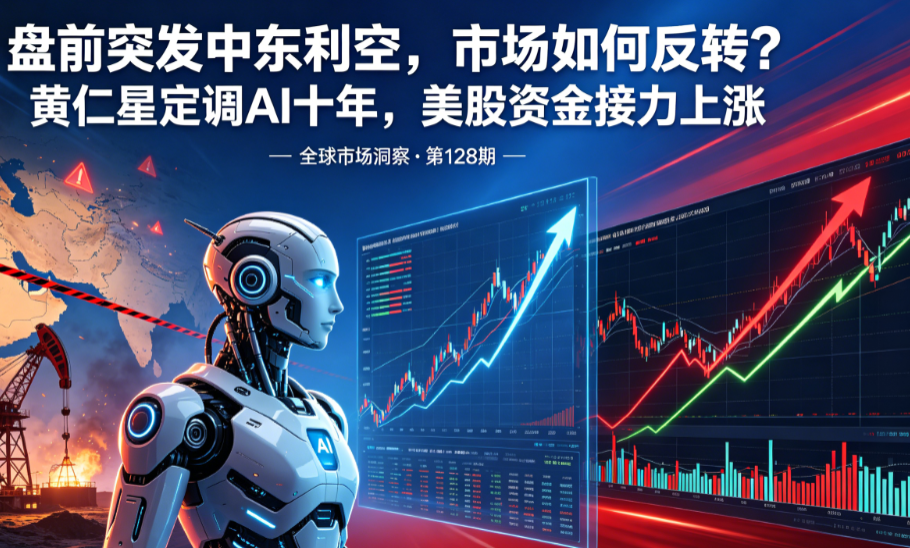
Today before the market opened, sudden bad news emerged, not from a US domestic economic data explosion, but from a suddenMiddle East geopolitical bearish event. News said Iran officially refused to continue negotiations and signaled plans to block two key maritime shipping lanes, including the Oman Strait. This single news directly triggered two major chain reactions in the capital market: global crude oil futures spiked straight up, the energy sector briefly surged, and tech and consumer growth stocks came under pressure across the board. The market's first instinctive reaction was straightforward: rising inflation would force the Fed to maintain high interest rates, and under high rates, growth tech stock valuations would inevitably be pressured. A complete bearish logic instantly filled the market, as if a full-scale Middle East war was about to erupt.
But the seed for the market's reversal was planted within half an hour of the opening. During the session, news emerged that Trump had actively stepped in to calm the situation. Trump publicly stated that he had not received any document confirming Iran's firm refusal to negotiate; the so-called refusal to negotiate and blockade of the strait was more of a verbal threat at the opinion level, not a final implemented policy. At the same time, the market traced the source of this Middle East conflict: the trigger originated from Israel's proactive strikes against Iran's overseas allies; the starting point of the conflict was not unilateral on Iran's side. To further stabilize market panic, Trump immediately called Israeli President Netanyahu during the session. The capital market immediately captured the signal from this call: the US holds communication channels with both Israel and Iran simultaneously. As long as the US is willing to mediate, it can temporarily restrain Israel's aggressive military actions and ease Iran's retaliatory mood, creating room for conflict de-escalation. The market immediately interpreted a simple logic: appeasing Israel equals stabilizing the overall Middle East situation. Iran's threat to block the strait is likely to remain a verbal deterrent and not actually implemented. Boosted by this news, the index quickly narrowed its losses, and the surging crude oil prices also pulled back slightly, calming panic.
We can step back from intraday news and look at the long-term fund direction. First, look at the long-term trend of crude oil and natural gas in commodity biddings. Short-term geopolitical news can only create price spikes; over a longer time horizon: global oil and gas supply is continuously increasing, with new oilfields in multiple countries coming online, stable production capacity release, and expanding LNG export routes. The global energy supply pie is steadily expanding. Even if the Middle East were to cut off a small part of shipping channels for a short time, oil and gas production capacity from other regions can fully fill the short-term gap. Geopolitical conflicts will only cause short-term bubbles in price increases, making it difficult to form a long-term sustained commodity bull market.
Next, dig deeper into the underlying nature of the Middle East war itself. Capital market funds have reached a consensus: once both sides enter a ceasefire, the difficulty of re-engaging in large-scale war is extremely high. The longer the ceasefire lasts, the exponentially lower the probability of war restarting. War essentially consumes both countries' fiscal and civilian resources; sustained conflict will drag down domestic economies, and public anti-war sentiment will continue to rise, creating huge domestic public opinion pressure on both governments. Combined with the US midterm election time window, this logic is further amplified. During the election cycle, the ruling party is most wary of large-scale overseas wars dragging down the domestic economy and raising inflation. Once a long-term Middle East war erupts, oil prices soar, pushing up domestic prices; voters' dissatisfaction will directly reflect in ballots—for election-seeking politicians, it's completely counterproductive. Therefore, both the US and Israel will actively avoid a full-scale war. Market funds have long seen this cycle logic, so they will not completely turn bearish on global stocks just because of an oral threat from Iran. Funds in the factory are generally betting on two ultimate outcomes: either the conflicting parties reach a compromise under multiparty mediation and return to the negotiating table, or the conflict continues at low-intensity friction, dragging on for a long time without escalating into a full maritime blockade or large-scale war. The market's performance completely confirms the iron law of capital markets: "News affects short-term sentiment; cycles determine long-term trends."
If the Middle East geopolitical news dominated the pre-market bearish atmosphere for US stocks, then Huang Renxun's major industry speech that day was the absolute core that lifted the index to a positive tone for the whole day. We set aside complex equipment parameters and hardware data, only dissecting the complete industry logic behind this speech to understand why an industry direction-setting could move the entire US tech sector. The core value of Huang's speech was not releasing new hardware products or short-term revenue, but directly giving the overall development direction for the AI industry over the next ten years, essentially setting a ten-year growth ceiling for the entire tech growth track and changing funds' judgment on the AI industry growth cycle.
First, Huang redefined AI not as a short-term fad but as the underlying infrastructure for the next decade of global digital transformation, much like the emergence of electricity and the internet decades ago—a technological revolution that permanently changes production models across all industries, with a growth cycle measured in decades, not short-term hype of two or three years. Currently, all industries worldwide—from manufacturing, healthcare, finance, retail to entertainment and agriculture—are in the early stages of AI application deployment; the vast majority of traditional enterprises have not yet deeply integrated AI technology, and the industry penetration space is extremely broad. The computing power demand explosion the market sees now is only the first stage of AI industry development. Subsequent enterprise deployment of AI applications, optimization of business processes, and construction of industry-specific large models will continue to generate a steady stream of computing procurement demand. Corporate capital expenditure will not peak in the short term; instead, it will continue to expand as applications proliferate. Huang shouted in Taipei: "Computing is revenue, watts are revenue, every token is revenue." He said the more tokens generated per watt, the more revenue. The content is comparable to "time is money" in the AI era.
Second, his speech conveyed a key industry logic: the AI industry has formed a complete upstream-downstream loop, where demand continuously self-generates new demand without a demand gap. Simply put, the proliferation of computing hardware lowers the barrier to developing large models, enabling more enterprises and institutions to develop domain-specific AI models. After massive industry-specific large models are deployed, they will in turn generate more procurement of computing, storage, and software, forming a positive cycle. Even if procurement pace slows in a particular quarter, the long-term industry expansion trend will not change. The industry growth has strong resilience and will not easily stall due to short-term economic fluctuations. Additionally, Huang pointed out the long-term rigid demand of digital transformation in countries worldwide: governments and enterprises are actively increasing AI investment and will not pause AI industry investment due to short-term geopolitical conflicts or commodity price hikes. For enterprises, AI is a core tool to reduce production costs and improve efficiency; long-term AI investment can continuously increase corporate profits. For governments, AI technological strength relates to future discourse power in global technological competition, and policies will continuously support the industry's development. From both policy and market ends, the AI industry's growth is protected.
The above is about the big industry trend. As for his own company, Huang gave reassurance. Today in Taipei, he did two things: put QDA into notebooks and moved trillion-parameter inference to the desktop. This is not NVIDIA competing with cloud providers—AWS, Azure, Google are NVIDIA's largest customers, purchasing hundreds of billions of dollars in GPUs annually—NVIDIA won't cut off its own golden patrons. What is really happening: NVIDIA is expanding its toll gates. Previously, AI computing had only one route: buy NVIDIA's GPUs and put them in cloud data centers. Now two more routes have appeared: RTX Spark notebook, DGX Station dedicated machine. Whichever you choose, NVIDIA is waiting at the intersection. Huang calls himself an infrastructure company. This means: it doesn't matter where AI runs; what matters is that NVIDIA has paved the roads. Someone summarized: "All roads lead to computing, and each has NVIDIA's toll gate." Of course, NVIDIA released a blockbuster product lineup—from the first data center GPU to the RTX Spark PC chip for the AI era, robot models, autonomous driving platforms, and AI factory solutions. NVIDIA is extending its reach to all aspects of the market.
Today, NVIDIA rose strongly, driving the overall US stock market higher. Market funds are very optimistic about the short-term tightness of AI hardware. NVIDIA's continuous expansion of downstream business makes investors more confident that the computing hardware industry chain can maintain high returns in the near term. Funds flocked to buy NVIDIA, directly strengthening the entire US tech sector. Market investors are all aware of the hidden long-term risks and understand that the next key period is whether AI applications can deliver profits. But the stock market trades on forward expectations. Everyone believes the hardware dividend cycle hasn't ended and there is room to operate for some time. Therefore, they prioritize embracing computing leaders like NVIDIA, pushing up the market. The danger here: the rally led by NVIDIA has a clear time boundary. We are currently in the stage where hardware dividends are spreading. When the entire hardware production chain dividend is fully released, and AI applications still fail to achieve profit breakthroughs, this rally will face a turning risk.
Look at other aspects. The US May ISM manufacturing data released today, and Powell's first public speech after leaving office did not produce any major surprises. First, the May ISM manufacturing index rose to 54, staying in expansion territory for five consecutive months. New orders rebounded strongly, with AI infrastructure investment driving demand growth in electronic equipment manufacturing. Although oil prices pushed up the raw material price sub-index slightly, the overall data was not overheating. The market judged that the Fed does not need to restart aggressive rate hikes, and the rate cut expectations that support growth stock valuations were preserved. Second, when receiving the award, Powell publicly opposed executive branch interference in Fed monetary policy, stating he would not change policy due to short-term oil price inflation fluctuations. His remarks throughout were neutral, neither hawkish on rate hikes nor giving a clear timetable for rate cuts.
This week, you can pay attention to the quantum computing newcomer QNT, which will list on the US stock market on June 4. The IPO aims to raise up to $1.46 billion, with an overall valuation hitting $13 billion, directly claiming the title of the largest quantum computing IPO in history. Technical specs are impressive, with good-looking data, and it has even developed a commercialized X-type quantum architecture. The US government just approved funds for nine quantum companies, and this one directly received $100 million in government support, giving it official endorsement. Subsequent military and government orders are expected to be fully priced in. The market now sees it as upgraded from a pure thematic concept stock to a hardcore track target with defense rigid demand. In the short term, it has the basis for thematic speculation, but it is not suitable for long-term value holding. Bullish support for speculation: first, it's at the right time, fitting the current market main line. With the AI stock market frenzy, the market broadly recognizes the integration of AI and quantum computing as the next-generation technology direction, the theme has ample momentum, and funds are willing to pay for cutting-edge tech stories. Second, its industry position is a real selling point: it is the largest pure quantum computing IPO to date, backed by Honeywell's technology accumulation and US government special industry funding, providing official endorsement, easily attracting short-term thematic funds and speculative retail investors. Third, there is market expectation of doubling: multiple investment banks have given optimistic target prices based on industry growth space, offering enough imagination for short-term funds to enter the game for the potential doubling story. However, its long-term investment value is thin, only suitable for short-term trading. The company currently suffers from large losses; it is still years away from commercial fault-tolerant quantum computer deployment, making stable profitability hard to see in the near term. Customer structure is single, revenue depends on a few partners. Technical fundamentals cannot support long-term high valuation. If you plan to hold for several quarters or even years, the risk-return ratio is poor. Overall, short-term moderate participation in thematic speculation is possible, but long-term holding is not recommended.
Finally, let's look at fund flows. Previously in late May, hedge funds were still secretly shorting semiconductors and positioning macro shorts. Within just a few weeks, these shorts defected, frantically chasing US stocks, with net buying scale hitting a six-month high. Long opening plus short covering pushed the market up from both sides. The US stock long-short leverage ratio reached a near-one-year high, with market risk appetite maxed out. In the first quarter of this year, retail trading volume fell to a four-year low. Then in May, retail bullish orders surged. Institutions predict that retail investors will make a major comeback in the second quarter. Historical data supports: whenever retail trading sentiment hits bottom and rebounds, the US stock market tends to perform well afterward. Retail investors are expected to become incremental funds for the next round of market rise. Hedge shorts plus institutional new long positions plus retail fund return—three layers of funds entering in sequence, combined with continuous AI industry chain earnings delivery, have led to an unusually long winning streak for the S&P and Nasdaq. Short-term market bullish sentiment is hard to cool quickly. However, at the same time, all funds are currently jammed into the tech AI track. Once funds begin to rotate out of this track, high-level tech stocks will face capital outflows. Historically, sectors where retail investors collectively hug at high levels tend to subsequently suffer a big pullback from profit-taking. The entire market is like a lively party: the music hasn't stopped, everyone is still dancing, but no one knows when the bell for leaving will ring.