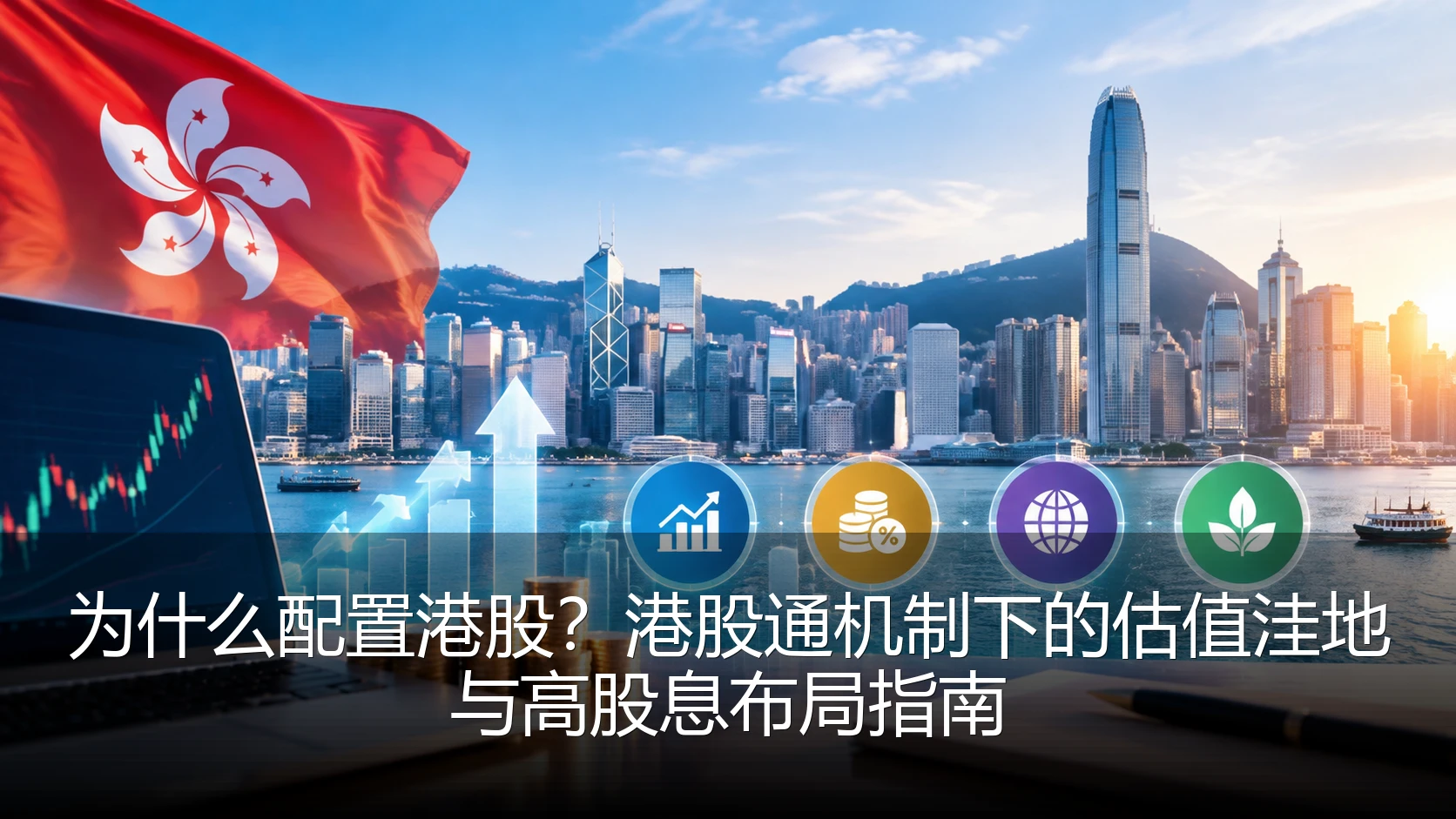
For mainland investors, the Hong Kong market was once an asset pool that was 'visible but unreachable': account opening was cumbersome, currency exchange was restricted, and information barriers were high. With the implementation of Shanghai-Hong Kong Stock Connect and Shenzhen-Hong Kong Stock Connect, the Stock Connect mechanism allows ordinary investors to participate in HK stock trading directly with RMB accounts. The question of 'why invest in HK stocks' has thus become a required course, not just a choice. This paper systematically reviews the core logic and practical points of HK stock allocation from five dimensions: mechanism, valuation, dividends, scarce assets, and portfolio diversification.
Stock Connect: The Golden Channel for Mainland Capital to Invest in HK Stocks
Shanghai-Hong Kong Stock Connect opened in November 2014, and Shenzhen-Hong Kong Stock Connect launched in December 2016, officially ushering in the era of interconnection between the two major markets. Stock Connect refers to the mechanism where mainland investors commission mainland securities companies to trade HK stocks on the HKEX through a securities trading service company established in both regions. Its value lies in three points: first, no overseas brokerage account is needed; trading can be done using existing A-share accounts. Second, the entire process is settled in RMB, which does not consume the individual's annual foreign exchange quota, creating a closed capital loop and significantly lowering compliance barriers. Third, the scope covers components of the Hang Seng Composite Large and Mid-Cap Index and H-shares of qualified A+H companies, essentially covering the blue-chip weights and core technology and pharmaceutical leaders of the HK market.
Quick Look at Stock Connect Mechanisms
- Trading Rules: T+0 turnover trading is implemented; stocks can be bought and sold on the same day. There is no price limit, and the volatility rhythm differs significantly from A-shares.
- Settlement Rate: Buying and selling are controlled by a reference rate, and final settlement is done by the settlement rate, resulting in a small foreign exchange cost between the two.
- Quota Allocation: Interconnection operates with daily quota management. Under normal circumstances, quotas are sufficient, and ordinary investors rarely feel restrictions.
- Scope Expansion: The scope is continuously optimized, and the weight of new economy is constantly increasing. Stock Connect has become a stage where mainland capital and international capital are jointly priced.
Logic 1: Valuation Safety Margin Built by AH Premium
For a long time, the stock prices of the same company in A and H regions have existed with a systemic discount. The Hang Seng AH Premium Index has long run above 100 points, meaning that A-shares are generally 'more expensive' than H-shares. The discount is due to differences in investor structure, liquidity, and capital costs. However, for allocative capital, buying the same fundamentals at a lower price is, in itself, a safety margin. When Southbound funds continuously flow in and market risk appetite recovers, the process of discount convergence is often accompanied by excess returns in H-shares, which is the fundamental reason why institutions have long viewed HK stocks as a 'value pocket.'
Logic 2: Quasi-Fixed Income Substitute from High Dividend Assets
HK stocks host a large number of undervalued, high-dividend blue-chip companies in the energy, banking, telecommunications, and utilities sectors, whose dividend yields are generally significantly higher than comparable A-share targets. In an environment where the risk-free rate is declining, the 'quasi-fixed income' nature of these assets is highly attractive to long-term funds such as insurance and pension funds, as well as individual investors seeking cash flow returns. It should be noted that dividends from HK Stock Connect individual investors are subject to a 20% personal income tax, and the actual tax burden of some offshore corporate structures is even higher. When calculating true dividend returns, taxes and foreign exchange factors must be included.
Logic 3: Scarce Assets Not Available in A-Shares
Another significance of investing in HK stocks is its 'uniqueness.' The HK market provides at least three types of assets scarce in A-shares:
- Internet Platform Leaders: Many leading mainland internet companies choose to list in HK or in both HK and the US. HK is a direct entry point to share the growth dividends of the digital economy.
- Innovative Drugs and Biotechnology: After the HKEX revised its listing rules in 2018 and added Chapter 18A, a large number of unprofitable biotech companies listed, forming a biotech sector that is difficult to replicate in A-shares.
- Global Business Exposure: Some companies derive most of their revenue from overseas markets and are priced in HKD or USD, naturally possessing hedging attributes against exchange rates and global economic cycles.
Logic 4: Portfolio Diversification Complementary to A-Shares
HK stocks are dominated by institutional investors and foreign capital, and their pricing logic is closer to global fundamentals and USD liquidity. There are natural differences between their industry weights and volatility characteristics compared to A-shares. Including a certain proportion of HK stocks in a portfolio can reduce dependence on a single market and smooth overall net value fluctuations. Furthermore, HK stocks have high Beta elasticity; growth indices like Hang Seng Tech often rise faster during the initial phase of a rally, giving them a dual tool function of defense (high dividend) and offense (tech growth).
Three Practical Suggestions: How to Include HK Stocks in a Portfolio
- Tool Selection: Investors with research capabilities can select individual stocks; those with limited time and energy can use Stock Connect ETFs or Hang Seng series index products to gain diversified exposure with one click, avoiding the risk of single-stock failure.
- Position Discipline: HK stocks are more volatile than A-shares. It is recommended to use a Core-Satellite strategy to control the HK stock proportion, building positions in batches to avoid chasing high prices with a single large position.
- Cost Accounting: Include the settlement exchange rate difference, dividend tax, and liquidity discount of some small and medium-cap stocks in the expected return, making decisions based on 'realized return' rather than 'nominal dividend yield'.
Risk Warning and Conclusion
HK stocks are significantly affected by global liquidity, exchange rates, and geopolitical factors. The lack of price limits can amplify short-term volatility, and high dividends do not equal zero risk; the sustainability of dividends also requires fundamental verification. Overall, the Stock Connect mechanism has significantly lowered the allocation barrier, and the three advantages—valuation discount, high dividends, and scarce assets—form a clear allocation logic. For investors aiming for asset diversification, HK stocks are suitable as a long-term strategic position in a portfolio, not as a short-term trading chip—achieving returns through time and discount recovery while understanding the rules and controlling positions.