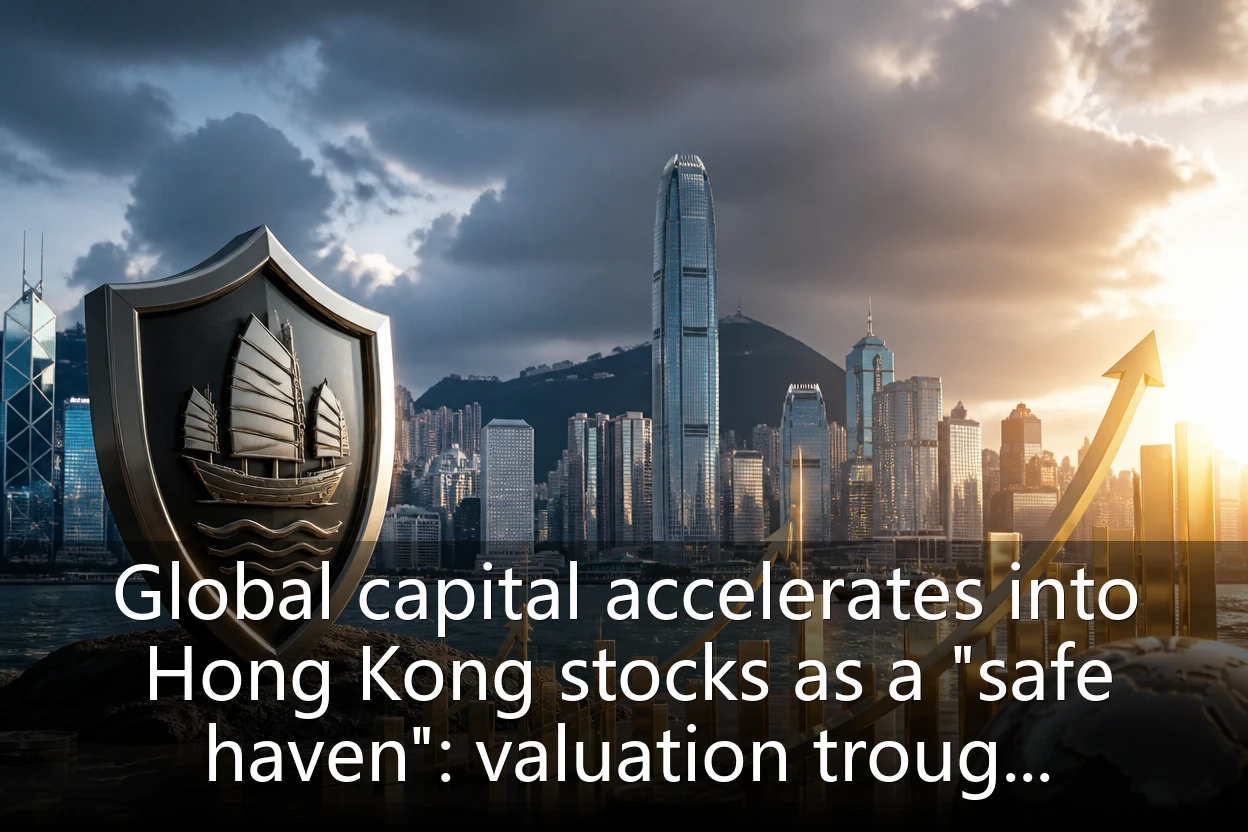
A Value Trough Amid Global Turmoil: Why Hong Kong Stocks Are Becoming a Capital "Safe Haven"
The first trading week of August 2026 saw global capital markets struggling amid wavering Fed rate hike expectations and intermittent geopolitical tensions. In stark contrast, the Hang Seng Index showed remarkable resilience around the 24,000-point level. By midday on August 2, net southbound inflows had surpassed HK$15 billion, setting a new single-day high for the past six months. This unusual capital flow has refocused market attention on a core issue: against the backdrop of a global asset shortage, why allocating to Hong Kong stocks has become a consensus strategy for large institutions and high-net-worth individual investors.
Valuation Trough Effect: Hang Seng Index PE at Historically Low Percentiles
For capital well-versed in value investing, the appeal of Hong Kong stocks lies primarily in their irreplicable "valuation trough" effect. As of early August 2026, the Hang Seng Index's forward price-to-earnings (PE) ratio was just 9.8x, with a price-to-book (PB) ratio below 1x. These metrics are not only far lower than the S&P 500's 22x but also significantly below the CSI 300 Index. From a historical percentile perspective, the Hang Seng Index's current valuation remains around the 15th percentile of the past decade.
This undervaluation stems not from collapsing corporate earnings but from a double blow of prior global liquidity tightening and suppressed geopolitical sentiment. As the Fed signals a dovish pause in rate hikes in the second half of 2026, the strong US dollar cycle is showing cracks, prompting capital to overflow from overvalued U.S. tech stocks and seek global valuation troughs. As an offshore market, Hong Kong's pricing power was once dominated by foreign capital. As foreign sentiment recovers, the elasticity of valuation reversion often exceeds expectations. For investors seeking a margin of safety, the low valuation advantage of Hong Kong stocks forms the most solid foundation for allocation.
High Dividend Strategy in Favor: Stable Returns with Payout Ratios Exceeding 5%
In an environment of gradually declining interest rate centers, the appeal of fixed-income assets has waned considerably, while the high dividend characteristics of Hong Kong stocks are becoming a ballast for institutional allocation. Data shows the overall dividend yield of the Hang Seng High Dividend Yield Index has climbed above 5.2%, with some large state-owned enterprises and utility stocks exceeding 6%.
This high dividend feature complements A-shares well. The A-share market focuses more on growth discovery, while the Hong Kong market gathers a large number of blue-chip enterprises with stable operations, ample cash flow, and a willingness to reward shareholders through high dividend payouts. Especially after the "China Special Valuation" concept emerged in the A-share market, mainland capital's recognition of high-dividend SOEs has significantly increased. Since the same company's Hong Kong share price is often lower than its A-share price, its dividend yield is relatively higher, further highlighting the cost-effectiveness advantage of Hong Kong stock dividends. Capturing high-yield targets southbound through the HKEX Connect mechanism has become an important path for long-term capital such as domestic pension and insurance funds to enhance absolute returns.
Record Southbound Inflows: Mainland Capital's Pricing Power Continues to Strengthen
Capital flow is direct evidence of market attractiveness. Since 2026, southbound funds have shown sustained and accelerating net inflows. Public market data shows that net southbound purchases in July again exceeded the HK$80 billion mark, with a surge in net inflows on August 2. This not only reflects mainland investors' bullish view on the Hong Kong market but also profoundly changes its ecological structure.
In the past, Hong Kong stocks were often criticized as a "sandwich layer," influenced by both A-share sentiment and foreign capital exodus. But now, with the continuous expansion of HKEX Connect eligible stocks, mainland capital's trading share in the Hong Kong market has risen to over 30%, significantly strengthening pricing power for technology, pharmaceutical, and consumer leaders. This optimization of the capital structure reduces the risk of severe volatility caused by irrational foreign capital withdrawal and enhances market stability. For mainland investors, allocating to Hong Kong stocks is no longer just a "going out" attempt but a cross-border advantage arbitrage based on familiar Chinese asset logic using the HKEX Connect mechanism.
International Advantages and Risk Hedging: Key to Diversifying Single-Market Volatility
Beyond valuation and dividends, the core logic of allocating to Hong Kong stocks lies in its unique international advantages. The Hong Kong market gathers numerous global multinational companies and internet and biopharmaceutical leaders not listed on A-shares. These targets have low correlation with A-shares, effectively diversifying the systemic risk of a single market.
For example, when the A-share consumer sector is under pressure, internet giants or innovative pharmaceutical stocks in the Hong Kong market may show independent trends due to their global layout. Additionally, the linked exchange rate system pegging the Hong Kong dollar to the US dollar provides mainland investors with a natural foreign currency asset hedging tool during periods of RMB exchange rate fluctuation. This multi-layered asset portfolio function cannot be provided by pure A-share allocation. With current global macroeconomic uncertainty intensifying, reducing overall portfolio volatility through Hong Kong stock allocation has become a required course for mature investors.
Investment Outlook: Seizing the Golden Window for Hong Kong Stock Allocation
In summary, the Hong Kong stock market in the second half of 2026 stands at the intersection of valuation recovery, improving liquidity, and warming sentiment. Although external uncertainties remain, extremely low valuations provide sufficient safety margins, while high-dividend assets lock in stable base returns. For investors still on the sidelines, now may be the window to review portfolio structures and moderately increase allocation to high-quality Hong Kong blue chips and high-dividend stocks. In specific operations, it is recommended to closely monitor the continuous flow of southbound funds and changes in the Hang Seng Index's valuation percentiles, using short-term market adjustments for phased positioning to enjoy the dual benefits of long-term Hong Kong stock valuation re-rating and corporate earnings growth.