Short Sellers Sweep Hong Kong Stocks: Three Major Indices Fall Together, Hang Seng Loses Key Level, Global Tech Stocks Adjust in Sync
Keywords: Hong Kong stocks; tech stocks; AI theme; sell-off; global stocks; rate hike expectations
I. Introduction: Hong Kong Stocks Hit Black Trading Day, Indices Hit One-Year Low
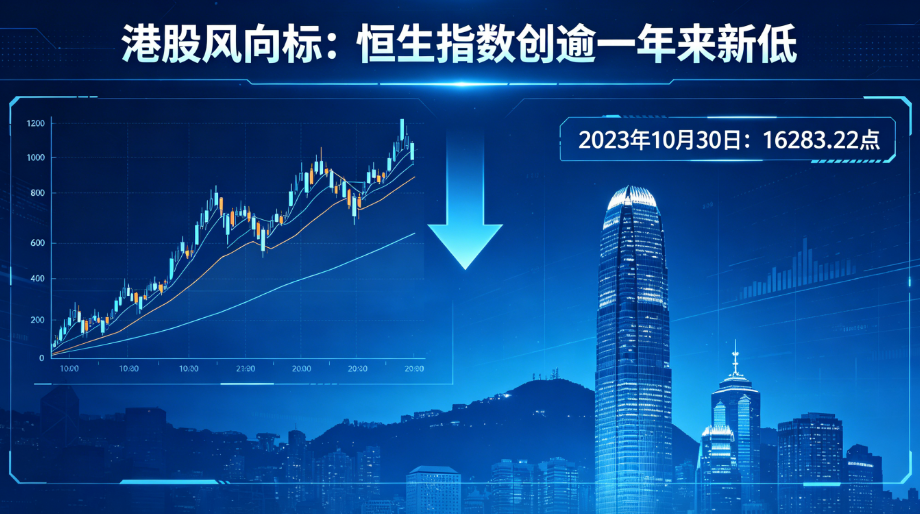
In April 2025 (Note: inferred from reference content as a recent market event, specific date omitted), Hong Kong stock market faced a new wave of fierce selling. The three major indices opened under pressure, extended losses in the afternoon, and closed collectively lower. At the close, the Hang Seng Index fell 1.76%, breaking below the 23,000-point mark to close near 22,987, a new low since last May; the H-shares Index fell 1.94%; the Hang Seng Tech Index plunged 3.41%, becoming the weakest sector of the day. Total turnover reached HKD 342.101 billion, indicating heavy selling pressure and intense bearish sentiment. Short-selling data showed total short-selling amount reached HKD 39.77 billion, accounting for 11.63% of the Hang Seng turnover, a ratio that has been steadily rising, suggesting sustained accumulation of bearish forces.
This adjustment is not an isolated event but a result of the combined pressure from global tech stock declines, macro headwinds, and fund flows. This article will combine market details, external environment, and institutional views to deeply analyze the causes, impact, and outlook of this Hong Kong stock rout.
II. Large Tech Stocks Lead Decline, AI Theme Fades, Market Confidence Crumbles
1. Tech stocks fall across the board, heavyweights hit new lows
On the trading board, large tech stocks were the hardest hit, directly dragging the Hang Seng Tech Index sharply lower. Alibaba fell nearly 6%, losing key support; Baidu fell 4.5%; Xiaomi Group fell 4%; Meituan, JD.com, and Tencent all weakened, hitting new lows. The collective decline of these heavyweights sharply cooled market sentiment, crushing investor confidence in the tech sector.
Technically, the Hang Seng Tech Index has accumulated a decline of over 20% since the beginning of the year, entering technical bear territory. This latest slump means the previous brief rebound is completely over, and the market has entered a new downtrend. Short-selling data also confirms this: SMIC, Yangtze Optical Fibre and Cable, and KB Laminates ranked top three in daily short-selling amounts, reaching HKD 1.85 billion, HKD 1.712 billion, and HKD 1.638 billion respectively, indicating accelerated capital outflows from previously hot sectors like semiconductors.
2. AI theme high-level pullback, long momentum completely broken
Besides tech stocks, the AI theme also fell into deep adjustment. Previously, the generative AI craze led by ChatGPT had driven a sharp rise in related Hong Kong stocks, with semiconductor, optical communications, and server supply chain stocks highly sought after. However, as market sentiment reversed, profit-taking from high levels in AI sector surged out, leading to widespread declines in semiconductors, optical communications, lithium battery, and auto stocks. Traditional sectors like finance, metals, and power also weakened, only a few consumer stocks such as home appliances, pork, and textiles managed to rise against the trend, but insufficient to offset the overall market decline.
The pullback in the AI theme is essentially a re-examination of high valuations and earnings realization ability. Recent price hikes by Apple and Microsoft for their products, citing surging chip and component costs, raised concerns about the "crowding-out effect" of the AI boom: on one hand, rising hardware costs squeeze downstream profits; on the other hand, over-investment in AI may divert resources from other industries, exacerbating structural imbalances. As the market realizes AI is not a risk-free "certain growth," the previously over-optimistic valuations face correction pressure.
III. Global Tech Stocks Fall in Sync, External Headwinds Add Pressure
1. Japan and South Korea stocks plummet, US stocks fall for four consecutive days
Hong Kong's crash is not isolated; global tech stocks are under collective pressure. On the same day, South Korea's KOSPI index triggered a circuit breaker again, Japan's Nikkei 225 closed down over 4%, and overnight the US Nasdaq composite index fell for four consecutive trading days, with selling sentiment rapidly spreading from North America to Asia-Pacific. The synchronized decline of global tech stocks reflects investors' shared concerns over interest rate environment, inflation pressure, and geopolitical risks.
2. Rate hike expectations heat up, liquidity concerns escalate
At the macro level, US federal funds rate futures show the market now prices a 76% probability of a rate hike by the Fed in September. The rising expectations directly push up the risk-free rate, suppressing the valuation logic of high-growth tech stocks. As a market with active international capital flows, Hong Kong is particularly sensitive to US dollar rate changes. When global capital shifts from risk assets to safe havens, emerging markets and Hong Kong stocks bear the brunt.
Moreover, the price hikes by Apple and Microsoft imply upstream cost pressures are being passed downstream. If this trend continues, it could push up overall inflation, forcing central banks to maintain tighter policies for longer. The market's expectation of "higher rates for longer" leads to valuation downgrades in the discounted cash flow model for tech stocks, which is one of the deep reasons for the collective sell-off in Hong Kong tech and AI concept stocks.
3. External risks disrupt, traditional sectors lack positive catalysts
Beyond tech stocks, traditional sectors also lack upward elasticity. Sectors like metals, power, and finance are constrained by uncertainty in macro economic data, making it hard for investors to form stable earnings expectations. Amid external risks, capital tends to flee volatile assets and seek certainty. That's why only some consumer stocks showed relative strength—home appliances, pork, and other defensive categories with low valuation and stable cash flows.
IV. A-share Market Also Adjusts, High Volatility May Become New Normal
1. A-shares shrink in volume, stocks fall broadly
As Hong Kong stocks plunged, A-shares also could not escape. The Shanghai Composite Index fell over 2%, and the Shenzhen Component Index also dropped sharply. Total turnover on the Shanghai and Shenzhen stock exchanges reached RMB 3.55 trillion, down RMB 41.9 billion from the previous trading day, indicating reduced trading willingness and lack of bargain-hunting capital. On the trading board, more than 4,600 stocks fell, with only a few sectors in the green, and hot spots were extremely scattered. The synchronized decline of A-shares and Hong Kong stocks further confirms that the market is in a stage of systemic risk adjustment.
2. Institutional view: high volatility may become the normal for now
Soochow Securities released a research report stating that the market will price in a higher risk premium due to macroeconomic data uncertainty. Investor risk appetite tends to be conservative, and a high-volatility environment may become the norm for a period. The institution believes that looking ahead, Hong Kong stocks need more catalysts for a trend reversal. Although the Hang Seng Tech Index currently offers attractive odds, there is a lack of significant incremental capital in the short term, and new catalysts are still needed.
In a high-volatility environment, institutions recommend focusing on high-dividend, stable cash flow assets to cope with potential systemic disruptions. This aligns with the previous market mantra of "embrace certainty" and explains why sectors like home appliances and textiles managed to rise against the trend—these industries have ample cash flows and stable dividends, offering some safe-haven appeal.
V. In-depth Analysis: Triple Pressures Behind Hong Kong Stock Crash
To understand the persistence and severity of this Hong Kong stock crash, at least three dimensions need to be analyzed in depth.
First, a double whammy of valuation and fund flows. After a previous sharp rally, valuations of Hong Kong tech stocks were generally at historical highs. Against the backdrop of rising Fed rate hike expectations and a stronger dollar, foreign capital outflow pressure increased. The short-selling ratio on the Hang Seng Index once again rose to 11.63%, indicating that bearish forces are accumulating. When upward momentum is exhausted and long confidence collapses, the market is prone to stampede-like rapid declines.
Second, rational return of the AI frenzy. AI concept stocks experienced huge gains between 2023 and 2024, but actual profit release in the supply chain still takes time. The price hikes by Apple and Microsoft reveal the impact of rising hardware costs on downstream companies, and also expose the difficulty of full commercialization of AI in the short term. When the market shifts from "story-telling" to "results-checking," high valuations become unsustainable, and a pullback is inevitable.
Third, the linkage effect of the global macro environment. The global economy currently faces multiple challenges: persistent inflation, high interest rates, and geopolitical tensions. Circuit breakers in South Korea's KOSPI, Nikkei's crash, and US stocks falling continuously all indicate fragile market sentiment. As an offshore market, Hong Kong is more directly affected by external influences. When global capital simultaneously withdraws from risk assets, Hong Kong stocks cannot stand alone.
VI. Conclusion and Outlook: Cautious in Short Term, Focus on Catalysts in Medium to Long Term
Overall, Hong Kong stocks are in an adjustment period under multiple pressures. After the Hang Seng Index fell below 23,000, the short-term technical picture has further deteriorated, and the market may test lower support levels in the future. Weak global tech sentiment, rising rate hike expectations, and valuation correction in the AI sector all weigh on Hong Kong stocks. From a flow perspective, the short-selling ratio continues to climb, indicating bears are still in control, and investors should remain cautious.
However, extremes often reverse. When the market is overly pessimistic, it may also breed new opportunities. Soochow Securities' observation that "the odds for the Hang Seng Tech Index are already very attractive" is not empty talk. Once the Fed's policy direction becomes clearer, or actual earnings surprises emerge in the AI supply chain, Hong Kong stocks could see a rebound opportunity. But before clear catalysts appear, the market is likely to remain highly volatile. Investors should control positions and focus on high-dividend, stable cash flow assets to weather this period of uncertainty.
The story of Hong Kong stocks is far from over. Until new macro and industrial signals emerge, patience may be the best strategy.