

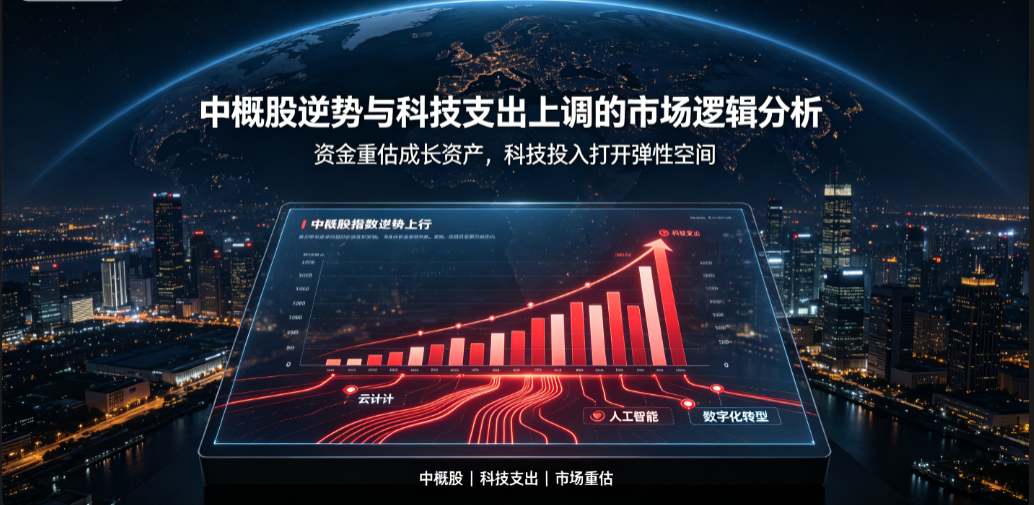
U.S. Stock Volatility and Chinese Concept Stocks' Contrarian Rally: Market Logic Behind the Tech Capex Guidance Uplift
Summary
Recent U.S. stock market has shown notable divergence: the chip sector suffered heavy losses with SanDisk plunging 12.6% and Google falling 4.4%, while Chinese concept tech stocks generally rose. Meanwhile, some tech companies raised their 2025 capital expenditure guidance to $60-64 billion, a significant increase from previous guidance. This article delves into the underlying logic of this divergence from multiple dimensions including macro environment, industry fundamentals, corporate strategy, and market sentiment, and explores the far-reaching impact of capex expansion on the semiconductor supply chain.
I. Introduction: Appearance and Substance of Market Divergence
In early Q2 2025, global capital markets experienced a wave of sharp fluctuations. All three major U.S. stock indexes closed lower, with the tech sector led by semiconductors bearing the brunt, while Chinese concept stocks moved against the trend, creating a stark contrast. Behind this superficial "ice and fire" scenario lies a repricing by investors of the pace of global economic recovery, the evolution of technology cycles, and geopolitical risks. More notably, multiple leading tech companies simultaneously raised their capex guidance during this adjustment, signaling strong confidence in future AI computing demand and data center expansion. This article aims to uncover the deep driving factors behind this complex picture.
II. U.S. Chip Sector Plunge: Short-Term Shock and Long-Term Concerns
2.1 SanDisk's 12.6% Crash: Cycle Turning Point for Memory Chip Prices?
SanDisk, as a global leader in memory chips, saw its stock plummet 12.6% in a single day, drawing market attention. The direct trigger was the company's quarterly revenue warning—due to continued price declines in NAND flash and weak downstream PC and smartphone demand, Q2 revenue is expected to fall below market expectations. This is not an isolated event. Earlier, major memory manufacturers such as Samsung Electronics and SK Hynix had already lowered their shipment guidance, indicating that the entire memory industry is entering a typical "de-stocking" phase.
On a deeper level, SanDisk's crash reflects the inherent cyclical volatility of the semiconductor industry. Since the second half of 2023, the explosive growth of AI large models has driven strong demand for HBM (High Bandwidth Memory) and DDR5 DRAM, pushing memory chip prices up rapidly. However, this structural demand driven by AI has not fully covered the traditional memory market—purchasing intentions for NAND in consumer electronics, automotive electronics, and other fields are weakening. When the short-term AI dividend fades and traditional terminal demand recovery remains sluggish, a cyclical price decline becomes inevitable.
2.2 Google's 4.4% Decline: Slowing Ad Growth and AI Investment Imbalance
Alphabet, Google's parent company, saw its stock drop 4.4%, mainly due to its advertising revenue growth rate falling below Wall Street expectations. Although Google Cloud maintained double-digit growth driven by AI services, the core profit driver—search advertising—faces fierce competition from platforms like TikTok and Amazon. At the same time, the company significantly increased capital expenditure on AI infrastructure—the 2025 budget grew over 40% from last year—putting pressure on operating margins.
The market's concern about Google is essentially a mismatch between "AI investment and commercial returns." While Google continues to ramp up investment in Gemini large models and TPU chips, investors are more focused on when these investments will translate into quantifiable revenue growth. Currently, generative AI commercialization is still in its early stages, and ad client adoption has not yet reached a tipping point. This contradiction of "high spending, low short-term returns" led to Google's stock being sold off after its earnings release.
III. Chinese Concept Stocks Rally: Capital Reallocation and Valuation Repair
3.1 Policy Tailwinds and Fundamentals Improvement
In contrast to the U.S. stock market's gloom, Chinese concept stocks saw broad gains this week. Internet giants like Alibaba, JD.com, and Pinduoduo averaged over 3% gains, and the new energy vehicle sector performed particularly strongly. Multiple factors support this phenomenon:
First, positive policy signals emerged. The China Securities Regulatory Commission recently signaled further optimization of overseas listing supervision processes and support for tech innovation companies' financing, easing market concerns about the delisting risk of Chinese concept stocks. Second, consumption recovery expectations strengthened. National Bureau of Statistics data showed that March's total retail sales of consumer goods grew 5.8% year-over-year, with online consumption contributing significantly. This macro data improvement provides earnings support for e-commerce platforms.
3.2 Valuation Pockets Attract Foreign Capital Inflow
From a valuation perspective, Chinese concept stocks have undergone deep adjustments over the past two years, with most internet companies' P/E ratios falling to the 10-15x range, below global peers. When U.S. tech stocks trade at historically high valuations with weakening growth expectations, some international capital shifts toward Chinese assets with more attractive valuations. Goldman Sachs' latest report indicates that its allocation ratio for Chinese tech stocks has been raised from "underweight" at end-2024 to "neutral," a shift directly reflected in recent net fund inflows.
IV. Sharp Capex Guidance Uplift: AI Arms Race Fully Escalates
4.1 $60-64 Billion: A Structural Strategic Shift
The most noteworthy industry dynamic this time is that multiple tech companies jointly raised their 2025 capex guidance from the previous $52-56 billion to $60-64 billion, an increase of about 15%. These funds will be primarily used for three areas: AI server and GPU cluster procurement, data center expansion, and in-house chip development capabilities.
Take Google as an example: 70% of its 2025 capex budget will go to AI infrastructure, including purchasing NVIDIA H100/B200 GPUs, deploying its self-developed TPU v5 chips, and building new cloud computing data centers. Amazon, Microsoft, and Meta have also announced similar expansion plans. This "collective leap" means tech giants have moved from a wait-and-see stance to active betting, believing AI will be the most deterministic growth engine for the next decade.
4.2 Transmission Effects on the Semiconductor Supply Chain
The capex uplift has dual implications for the semiconductor industry. In the short term, it alleviates concerns about declining chip demand—if hyperscale cloud providers continue to increase procurement, orders for GPUs, AI accelerators, and high-bandwidth memory will keep growing, offsetting some weakness in traditional chips. However, in the long run, overly concentrated capex may also bring oversupply risks. When all giants expand data centers simultaneously and AI application commercialization is slower than expected, computing capacity may be periodically wasted.
Notably, this uplift also reflects tech companies' strategic desire for "chip independence." Microsoft is accelerating Azure custom chip development, and Google wants to reduce reliance on third-party GPUs. This trend will reshape the global semiconductor value chain and create new competitive pressures for traditional chip makers.
V. Outlook: Investment Logic in Continuing Divergence
5.1 U.S. Chip Sector: Cautious Optimism, Focus on Structural Opportunities
Looking ahead, the U.S. semiconductor sector may continue to face pressure, but it holds structural opportunities. Investors should focus on three major directions: first, AI chip-related companies like NVIDIA and AMD, which still have high order visibility; second, analog chip makers with pricing power, more resilient during cyclical swings; and third, equipment and materials suppliers that can directly benefit from tech giants' capex spending.
5.2 Chinese Concept Tech Stocks: Sustainability Test for Recovery Rally
Whether the Chinese concept stock recovery is sustainable depends on three key variables: first, the actual strength of domestic economic recovery, especially consumer and manufacturing data; second, the direction of U.S.-China relations, particularly whether U.S. semiconductor export controls on China are further tightened; and third, whether companies' own earnings improvements materialize. At this stage, we recommend focusing on platform companies with strong cash flows and buyback capabilities, while avoiding AI startups still in losses.
VI. Conclusion
The current divergence between U.S. stock declines and Chinese concept stock gains is not a simple shift in market sentiment, but an inevitable manifestation of the global tech industry transitioning between cycles. The chip sector's adjustment results from a temporary mismatch between industry cycles and technology innovation pace, while tech giants' collective capex uplift demonstrates firm faith in AI's long-term prospects. For investors, finding certainty amid divergence—both capturing the dividends of AI infrastructure and avoiding cyclical risks—is essential. In the future, as capex deployment releases production capacity, the semiconductor supply chain will enter a new round of "survival of the fittest," where only companies with genuine technological moats and business model resilience will emerge victorious in this arms race.

