Southbound capital sees weekly net inflow exceeding HK$1.5 billion: AI and high dividend dual themes drive, HK stock allocation window heats up again
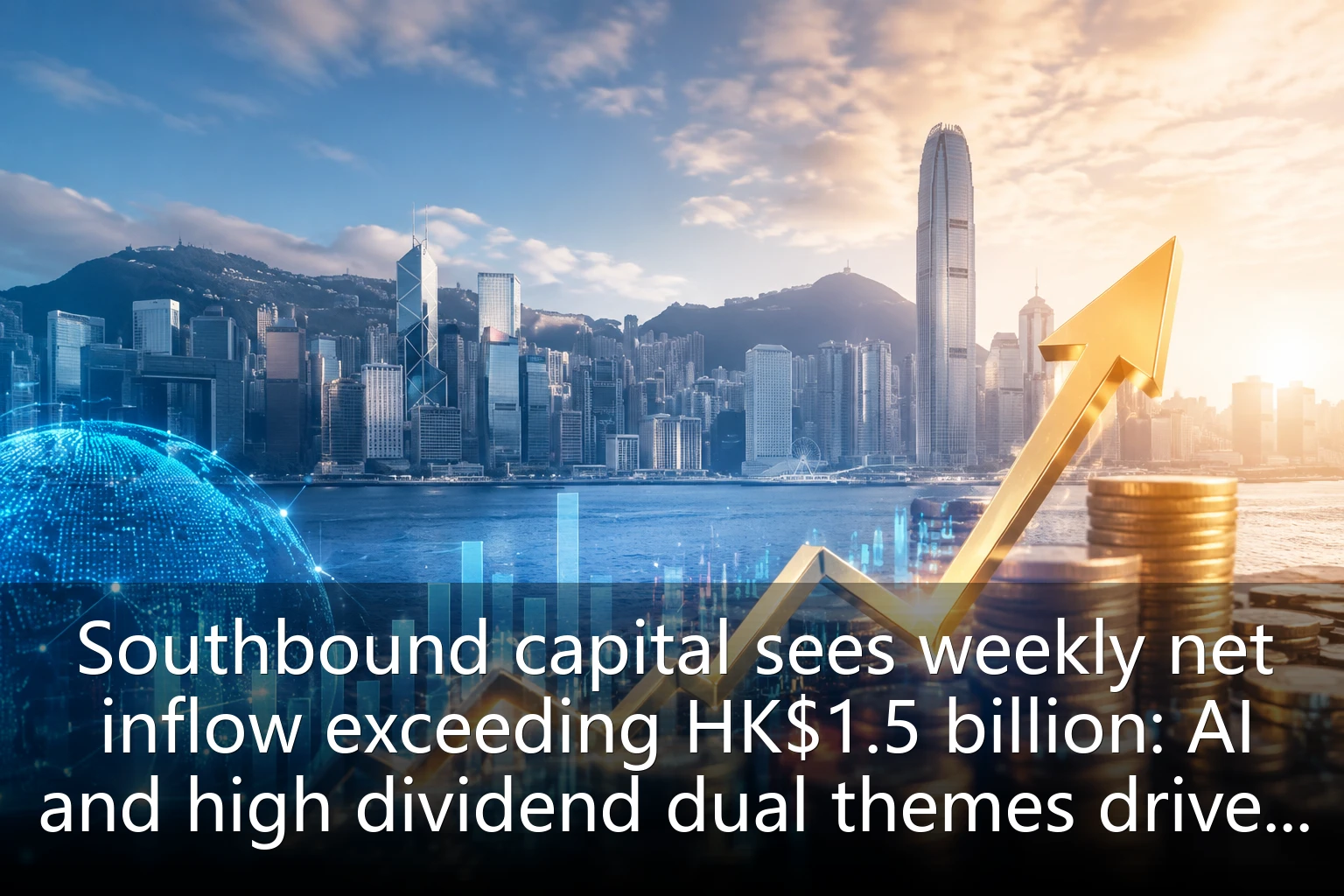
On August 23, 2026, Hong Kong's stock market welcomed key capital flow data. Latest statistics show southbound capital's weekly net inflow broke through the HK$1.5 billion mark, setting the largest weekly net inflow record since May this year. This data not only reflects the continued warming of mainland investors' allocation enthusiasm for the HK stock market but also highlights the significant appeal of AI and high dividend dual-theme investment strategies in the current market environment.
Interpreting Capital Flow Data: Market Logic Behind Historic Inflows
According to the latest data disclosed by the Hong Kong Stock Exchange, for the week ending August 20, southbound capital net bought HK stocks via the Stock Connect channel at HK$15.28 billion, a 68.5% surge from the previous week. This growth far exceeded market expectations and marked the third consecutive month of strong inflows for southbound capital.
From the capital allocation structure, tech stocks and high dividend sectors became the absolute main force. Among them, AI-related concept stocks received net purchases of about HK$7.8 billion, accounting for over 50%; while traditional high dividend sectors attracted capital inflows of about HK$4.5 billion, with the two together occupying over 80% of southbound capital allocation.
Market analysts point out that this capital flow change is closely related to the current global macroeconomic environment. The expectation of a Fed rate cut in September rose to 85%, and the expectation of global liquidity easing strengthened, making the HK stock market with relatively reasonable valuations more attractive. At the same time, mainland investors are seeking a balance between stable returns and growth opportunities, and AI and high dividend恰好 meet this demand.
AI Sector: Dual Drive of Technological Breakthroughs and Policy Support
Behind the strong performance of the AI sector is the dual drive of technological breakthroughs and policy support. Recently, several HK-listed tech companies have released remarkable AI technology progress, especially breakthroughs in large models, autonomous driving, and smart chips, which have attracted high market attention.
Taking Tencent Holdings as an example, its newly released AI assistant " Hunyuan" made major breakthroughs in multimodal processing capabilities, and the market expects this to bring new growth points. Affected by this, Tencent's stock price rose 3.2% this week, becoming one of the key allocation targets for southbound capital.
Alibaba-SW also performed impressively, with its Tongyi Qianwen large model making breakthroughs in multilingual processing and complex reasoning capabilities, and the market is full of expectations for its commercialization prospects. In addition, tech stocks like Xiaomi Group and Meituan also received capital favor due to AI-related business progress.
At the policy level, the Hong Kong SAR government's recently launched "Digital Economy Promotion Plan" provides strong support for AI industry development, including tax incentives, R&D subsidies, and other policy measures, further enhancing market confidence in HK-listed tech companies.
High Dividend Sector: Perfect Combination of Valuation Advantage and Stable Returns
Meanwhile, the appeal of the high dividend sector cannot be ignored. In the current low-interest-rate environment, assets that can provide stable cash returns have become an important choice for investors. Many blue-chip stocks in the HK stock market, with their high dividend yields and low valuation advantages, have become key directions for southbound capital allocation.
Financial stocks are the core component of the high dividend sector. Bank stocks like HSBC Holdings and Standard Chartered, with their stable operating performance and high dividend yields, have attracted a large amount of long-term capital. Among them, HSBC Holdings' dividend yield has exceeded 6%, becoming a key target for southbound capital allocation.
Utility stocks also performed prominently. Enterprises like Hongkong Electric and Towngas, with their stable cash flow and continuously growing dividends, have become the first choice for defensive investors. These companies usually have stable profitability and high dividend payout ratios, able to provide reliable cash returns for investors.
In addition, some real estate stocks like Cheung Kong Group and Sun Hung Kai Properties have also attracted attention due to their high dividend yields. Although the real estate industry faces structural adjustments, these leading enterprises, with their strong brand influence and stable rental income, can still maintain high dividend levels.
Industry Impact: Reshaping HK Stock Market Structure Through Capital Flow
The continuous inflow of southbound capital is reshaping the investment structure of the HK stock market. On one hand, the concentrated allocation of capital to AI and high dividend sectors has intensified market differentiation. The valuation levels of tech stocks and high dividend stocks continue to rise, while traditional manufacturing and cyclical sectors are relatively under pressure.
On the other hand, this capital flow also promotes the internationalization process of the HK stock market. With the continuous inflow of southbound capital, the linkage between the HK stock market and the mainland capital market is further strengthened, and the market structure becomes more diversified.
For listed companies, the preference of southbound capital is affecting their business strategies. Many companies are beginning to pay more attention to shareholder returns, increasing dividend payout ratios; at the same time, they are increasing investment in emerging technology fields like AI to attract long-term capital.
From the perspective of market liquidity, the continuous inflow of southbound capital provides a stable source of funds for the HK stock market, helping to improve overall market liquidity and reduce volatility.
Investment Strategy Recommendations: Key Points to Grasp the Allocation Window
Facing the current market environment, how should investors grasp the HK stock allocation window? Experts suggest starting from the following aspects:
- Balanced allocation of AI and high dividend: While maintaining focus on AI growth stocks, appropriately increase the allocation proportion of high dividend sectors to achieve a balance between risk and return.
- Pay attention to valuation rationality: Although hot sectors perform strongly, investors still need to pay attention to valuation levels to avoid excessive chasing of highs. Choose targets with sustainable competitive advantages and reasonable valuations.
- Combine long-term holding and swing trading: For core positions, it is recommended to adopt a long-term holding strategy; for hot theme stocks, appropriate swing trading can be conducted to grasp short-term opportunities.
- Diversify investment to reduce risk: Maintain moderate diversification in industry and individual stock selection to avoid concentrated risk. ETFs and other tools can be considered to achieve industry diversification.
- Pay attention to policy trends: Closely monitor changes in macro factors such as Sino-US relations, Fed policies, and Hong Kong local policies, and adjust investment strategies in a timely manner.
Future Outlook: Re-evaluating HK Stock Allocation Value
Looking ahead, the trend of continuous inflow of southbound capital is expected to continue. On one hand, mainland investors' awareness and participation in the HK stock market are continuously increasing; on the other hand, the HK stock market's own appeal is also strengthening, including valuation advantages, internationalization level, and institutional advantages.
From a valuation perspective, although the valuations of some sectors have risen recently, overall, the HK stock market still has relative valuation advantages. The P/E ratio of the Hang Seng Index is at a mid-to-low historical level, and there is still a discount compared to the A-share market, which provides good allocation opportunities for long-term investors.
From an institutional perspective, the Hong Kong Stock Exchange's multiple reform measures in recent years, such as simplifying the second listing threshold and optimizing trading mechanisms, are enhancing the competitiveness of the HK stock market, attracting more high-quality enterprises to list in Hong Kong and further enriching market investment targets.
However, investors also need to pay attention to potential risk factors. Including global economic uncertainty, geopolitical risks, changes in Sino-US relations, etc., may have a short-term impact on the market. Therefore, while actively grasping allocation opportunities, maintaining risk awareness is equally important.
Conclusion: Rational Layout, Grasp Long-term Opportunities
The record of southbound capital's weekly net inflow exceeding HK$1.5 billion not only reflects the preference of capital for HK stocks in the current market environment but also reveals the effectiveness of the AI and high dividend dual-theme investment strategy. In this context, investors should make rational layouts, grasping short-term opportunities while focusing on long-term value.
As an important bridge connecting the mainland and the world, the HK stock market's allocation value is being recognized by more and more investors. With the continuous inflow of southbound capital and the continuous optimization of the market structure, the HK stock market is expected to usher in a healthier and more sustainable development stage. For investors, now is a good time to re-evaluate and layout HK stock allocation.