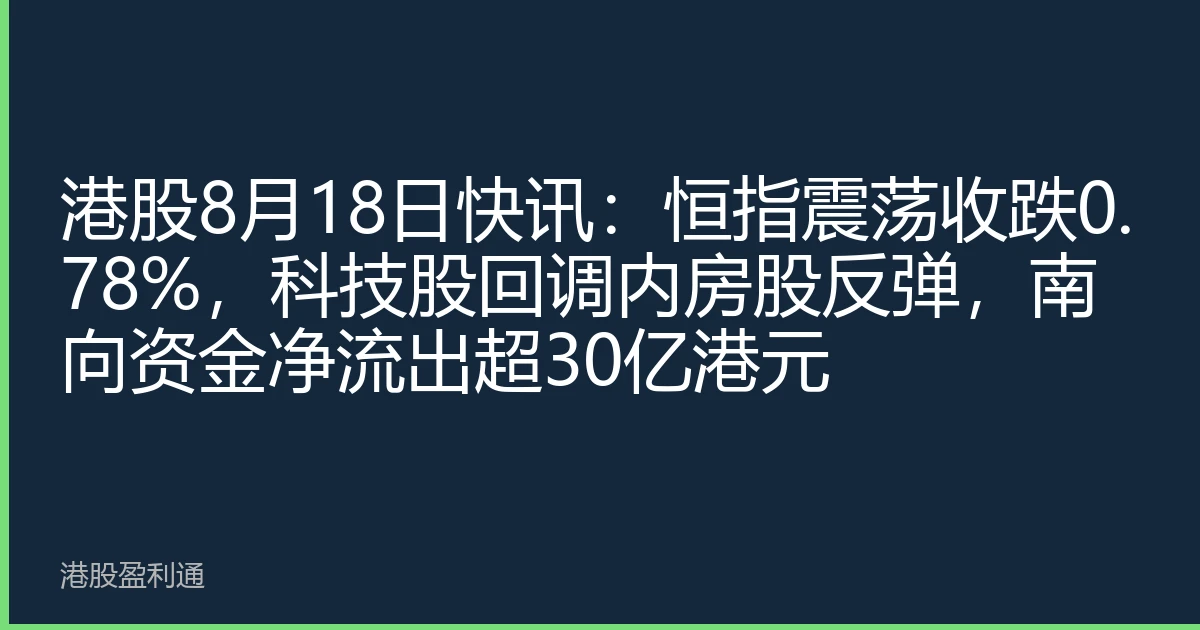
On August 18, the HK stock market continued its volatile adjustment trend, with the Hang Seng Index showing a weak downward trend throughout the day. As of closing, the Hang Seng Index was 23,856.42 points, down 0.78%, with trading volume increasing compared to the previous day. Market analysts pointed out that the market sentiment on that day was influenced by multiple factors, including external market fluctuations, Mainland economic data, and performance expectations of certain sectors.
Overall Market Performance
The HK stock market was weak after opening on that day. The Hang Seng Index briefly dropped to the 23,750 mark in the morning, and although there was a rebound in the afternoon, the momentum was limited, ultimately closing at 23,856.42 points, down 0.78% for the day. In terms of volume, the total turnover reached 125 billion HKD, an increase from the previous day's 118 billion HKD, indicating improved market activity.
The Hang Seng China Enterprises Index performed slightly better than the Hang Seng Index, closing down 0.65% at 8,923.15 points. The Red Chip Index closed down 0.92% at 4,231.78 points. Looking at industry sectors, the market showed clear differentiation today: tech stocks generally corrected, while property stocks rebounded.
Sector Performance Analysis
Tech Stocks Generally Correct
Tech stocks were the main drag on the market today. The Hang Seng Tech Index closed down 1.23% at 6,789.45 points. Among them, internet giants Tencent Holdings (0700.HK) closed down 1.45%, Alibaba (09988.HK) closed down 1.82%, and Meituan (03690.HK) closed down 2.15%. Market analysis suggests that the correction in tech stocks was mainly influenced by the following factors:
- External Market Volatility: Recent poor performance of US tech stocks puts pressure on HK tech stocks.
- Earnings Expectations: Some tech stocks missed Q2 expectations, causing investor concern.
- Policy Factors: Uncertainty remains regarding regulatory policies for internet platforms in Mainland China.
However, it is worth noting that some semiconductor and new energy-related tech stocks performed relatively resiliently, showing a preference for specific tech sub-sectors in the market.
Property Stocks Rebound
In sharp contrast to tech stocks, property stocks generally rebounded today. The Hang Seng Real Estate Index rose by 1.12%, with leading real estate companies performing particularly well. Country Garden (02007.HK) rose by 3.45%, Vanke (02202.HK) rose by 2.78%, and Poly Developments (01898.HK) rose by 1.89%. Analysts pointed out that the rebound in property stocks was mainly driven by the following factors:
- Policy Support: Mainland China recently introduced multiple policies supporting the real estate market, including lowering down payment ratios and adjusting mortgage rates.
- Valuation Repair: Property stocks, after a long adjustment, are at historically low valuations, possessing some attractiveness.
- Capital Inflow: Some capital shifted from tech stocks to lower-valued real estate stocks.
Fund Flow Analysis
Southbound funds showed a net outflow today, selling approximately 3.2 billion HKD of HK stocks throughout the day, a clear shift from the net purchase of 2.5 billion HKD the previous day. In terms of sector flow, Southbound funds mainly reduced holdings in tech and consumer stocks while increasing holdings in property and financial stocks.
Specifically, tech giants like Tencent Holdings and Alibaba faced reductions from Southbound funds, while property stocks like Country Garden and Vanke received increases from Southbound funds. Market analysis suggests that the change in Southbound fund flows reflects Mainland investors adjusting their market style, shifting from high-valuation tech stocks to low-valuation value stocks.
Key Market Influencers
External Market Volatility
The external market performed poorly today. The US Dow Jones Index closed down 0.65%, and the Nasdaq Index closed down 1.12%, putting pressure on the HK stock market. The market is concerned about the potential extension of the Fed's tightening cycle and the global economic slowdown, leading to decreased risk appetite.
Mainland Economic Data
Mainland China's economic data for July was released, showing that the economic recovery process still faces challenges. Industrial added value growth was below expectations, and consumer data was also mediocre. This data influenced market expectations for the Mainland economy, which in turn affected the HK stock performance.
Industry Policy Changes
Uncertainty remains regarding the regulatory policies for internet platforms in Mainland China. Although no major new policies were introduced recently, market concerns about policy risks have not been completely eliminated. Furthermore, increased policy support for the real estate industry provided support for property stocks.
Outlook
Regarding the future, market analysts believe that the HK stock market will maintain a volatile pattern in the short term, but long-term configuration value still exists. Here are several key points to watch:
- Fed Policy: Expectations of a Fed rate hike in September have cooled, but the market still needs to pay attention to inflation and employment data.
- Mainland Economic Policy: Mainland China may introduce more measures to stabilize growth, providing support to HK stocks.
- Corporate Earnings: The Q2 earnings season is nearing its end, and corporate performance will influence market sentiment.
- Fund Flow: Changes in Southbound fund flows will reflect Mainland investors' confidence in HK stocks.
From an investment strategy perspective, it is recommended that investors pay attention to low-valuation, high-dividend blue-chip stocks and cyclical stocks that benefit from the Mainland economic recovery. At the same time, the long-term investment value of tech stocks is still worth watching, but short-term volatility risks must be noted.
Investment Recommendations
Overall, the HK stock market showed a downward trend with fluctuations on August 18, with tech stocks correcting and property stocks rebounding, and Southbound funds seeing a net outflow. The market was influenced by multiple factors, including external market volatility, Mainland economic data, and industry policy changes. For investors, it is recommended to maintain a cautious attitude, focus on low-valuation blue-chip and cyclical stocks, and control positions to avoid blindly chasing high prices.
As the Mainland economy gradually recovers and the Stock Connect mechanism continues to improve, the long-term investment value of the HK stock market still exists. Investors should pay attention to market dynamics, flexibly adjust investment strategies, and seize structural opportunities.