

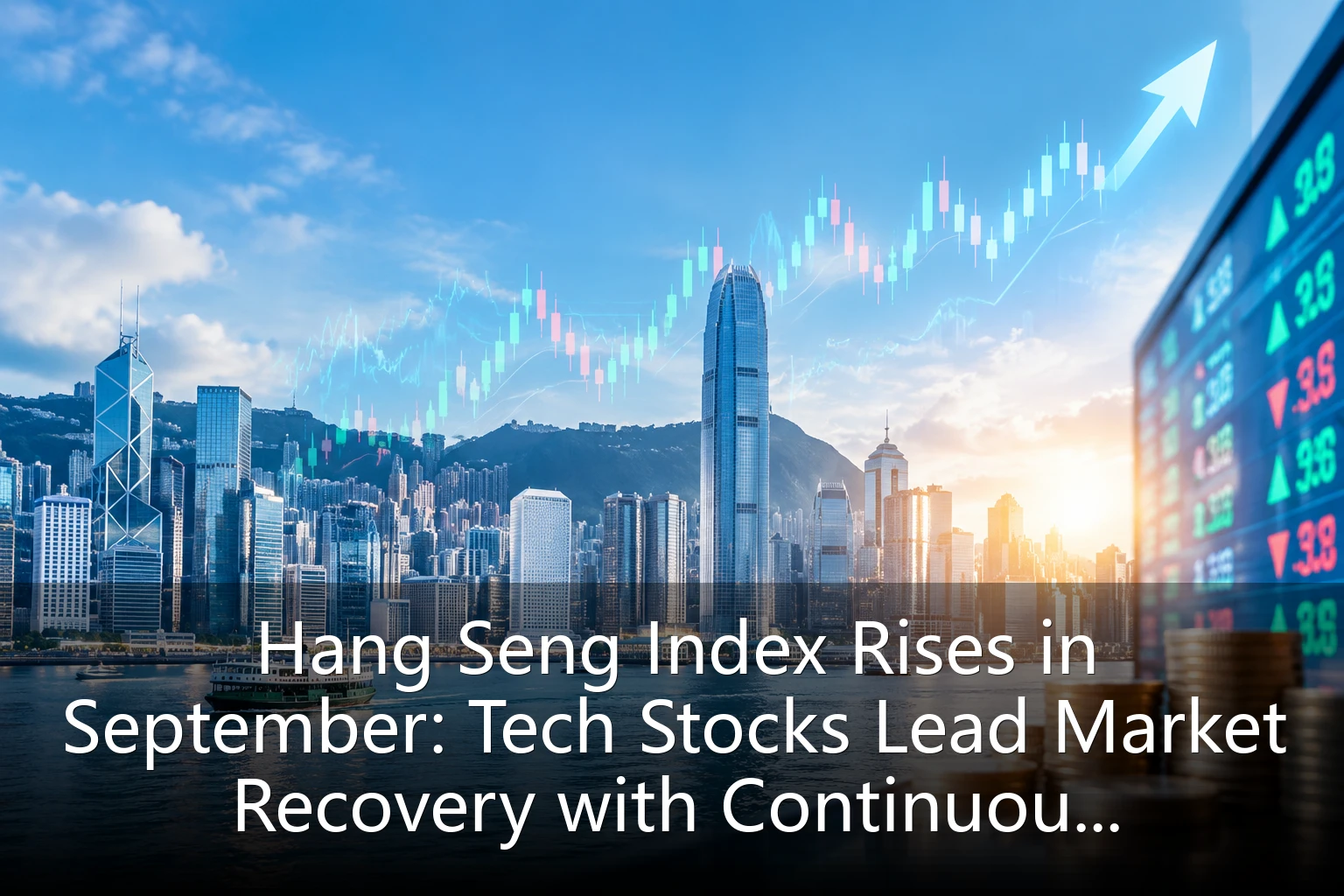
Hang Seng Index Rises in September: Tech Stocks Lead Market Recovery with Continuous Northbound Inflows Reaching New High
\nIn September 2026, the Hong Kong stock market showed an upward trend with fluctuations. After adjustments early in the month, the Hang Seng Index gradually recovered, showing strong performance especially in the latter half. Market analysts point out that the strong performance of tech stocks became the main driving force for the index's rise, while continuous northbound investment provided solid financial support. This article will analyze the current market trends and investment opportunities in Hong Kong from multiple dimensions.
\n\nHang Seng Index Performance Review for September
\nSince the beginning of September, the Hang Seng Index has shown an upward trend with fluctuations. According to market data, the index once fell to around 23,000 points in early September, but as market sentiment gradually improved, the index rebounded quickly and broke through the 24,000-point mark. By the close of September 23, the Hang Seng Index closed at 24,358.67 points, an increase of about 5.3% compared to the end of August, with a cumulative trading volume exceeding 4.5 trillion Hong Kong dollars for the month.
\nFrom a technical perspective, the Hang Seng Index formed a clear "V-shaped" reversal pattern in September. The early-month adjustment was mainly affected by increased volatility in global financial markets and some economic data falling short of expectations. However, as market expectations for a Federal Reserve rate cut in September strengthened and the valuation advantage of Hong Kong stocks became more prominent, the index began to stabilize and rise in mid-month, gradually recovering lost ground.
\n\nTech Stocks Lead Market Recovery
\nIn the September Hong Kong stock market, the tech sector was undoubtedly the brightest star. The tech sector, represented by the Hang Seng Tech Index, rose by more than 7% for the month, significantly outperforming the broader market. Among them, artificial intelligence, cloud computing, and semiconductor sub-sectors performed particularly well, with many leading stocks reaching new highs for the year.
\nThe strong performance of tech stocks was driven by multiple factors. First, the global tech industry showed clear signs of recovery, especially the accelerated commercial application of artificial intelligence technology, with related companies continuously raising earnings expectations. Second, Hong Kong tech stocks still trade at a discount compared to similar US-listed stocks, attracting international fund reallocation. Additionally, the "Digital Economy Blueprint" recently launched by the Hong Kong SAR government has provided policy support for tech stocks.
\nSpecifically, AI concept stocks became the market focus. Several leading AI companies launched new products and solutions in September, driving stock prices higher. The cloud computing sector also performed strongly, with order volumes for leading companies significantly increasing as demand for digital transformation grows. The semiconductor industry benefited from the global chip demand recovery and accelerated domestic substitution processes, showing a steady upward trend in stock prices.
\n\nNorthbound Funds Continue to Increase Hong Kong Exposure
\nIn terms of capital flows, northbound funds performed exceptionally well in September. Data shows that as of September 23, northbound funds had a cumulative net inflow of over 80 billion Hong Kong dollars for the month, setting a new high for the year. This data not only reflects increased confidence of mainland investors in the Hong Kong market but also highlights the allocation value of Hong Kong stocks in the current market environment.
\nThe continuous inflow of northbound funds is mainly based on several considerations: First, the overall valuation of the Hong Kong market is at a relatively low historical level, especially compared to A-shares, with the average P/E ratio of Hang Seng Index components still at a low level among major global markets, offering higher safety margins and investment attractiveness. Second, the high dividend characteristic of Hong Kong stocks is particularly valuable in the current interest rate environment, providing mainland investors with a stable income source. Additionally, with continuous improvements to the Hong Kong Stock Connect mechanism and expansion of investable products, mainland investors have more convenient channels to participate in the Hong Kong market.
\nIn terms of industry distribution of capital flows, tech stocks, consumer stocks, and financial stocks were the key directions for northbound fund allocation. Among them, the tech sector received the highest favor, with cumulative net inflows exceeding 30 billion Hong Kong dollars, accounting for nearly 40% of total northbound inflows. Consumer and financial stocks received approximately 20 billion and 15 billion Hong Kong dollars in net inflows respectively, showing continued optimism from funds toward these traditional strength sectors.
\n\nMacroeconomic Environment and Market Sentiment Analysis
\nFrom a macroeconomic perspective, the policy directions of major global economies have had a significant impact on the Hong Kong market. The market widely expects the Federal Reserve to start a rate cut cycle in September, which has boosted performance of global risk assets. As an international financial center, Hong Kong's capital market is highly sensitive to global liquidity changes, and the increased expectation of Fed rate cuts has provided a favorable external environment for the Hong Kong market.
\nRegarding the domestic economy, the gradual implementation of a series of growth-stimulating policies has begun to show effects, with economic data showing signs of stabilization and recovery. Especially the improvement of key indicators such as consumption and manufacturing PMI has provided fundamental support for related sectors in the Hong Kong market. Additionally, the relative stability of the RMB exchange rate has created a favorable capital environment for the Hong Kong market.
\nIn terms of market sentiment, as the Hang Seng Index gradually recovered and broke through key resistance levels, investor confidence significantly increased. The improvement in market risk appetite is reflected not only in the index's performance but also in increased trading volumes and rising volatility of individual stocks. However, market experts also remind investors that the global economy still faces many uncertainties, market volatility may intensify, and investors should not blindly chase highs.
\n\nDifferentiated Performance of Industry Sectors
\nIn the September Hong Kong stock market, different industry sectors showed clearly differentiated performance. Besides the outstanding performance of tech stocks, other major sectors each had their own characteristics.
\nThe consumer sector showed an overall upward trend with fluctuations in September. With the approach of holiday consumption season, retail, catering and other sub-industries received market attention. Especially leading consumer companies with brand advantages attracted stable-type fund allocation with their stable earnings growth and continuous dividend policies. However, differentiation also occurred within the consumer sector, with consumer staples outperforming discretionary consumer goods, reflecting that consumers remain conservative in the current economic environment.
\nThe financial sector performed relatively steadily in September. Bank stocks benefited from changes in the interest rate environment, with net interest margin pressure easing and valuations recovering. Insurance stocks benefited from increased investment returns due to the capital market recovery, showing more positive stock price performance. However, the real estate sector still faces adjustment pressure, with debt problems of some highly leveraged developers continuing to drag on the sector's overall performance.
\nThe energy sector showed fluctuating trends in September. Fluctuations in international oil prices caused energy stock performance to follow market sentiment changes. However, the new energy sector performed impressively, especially photovoltaic and wind-related companies benefiting from accelerated global energy transition and policy support, with stock prices continuously rising.
\n\nInvestment Strategy and Risk Warnings
\nFacing the current market environment, how should investors seize Hong Kong investment opportunities? Market experts recommend adopting a "core + satellite" investment strategy, using low-valuation, high-dividend blue-chip stocks as core allocation while appropriately allocating growth-oriented tech stocks as satellite positions.
\nSpecifically, for core allocation, investors can focus on the following types of assets: first, blue-chip stocks with stable cash flows and high dividend rates, such as utilities and telecommunications services; second, financial stocks with valuations at historical lows and solid fundamentals, especially large state-owned banks and quality insurance companies; third, leading companies in the consumer sector, especially those with brand advantages and pricing power.
\nFor satellite allocation, tech stocks remain a key focus area. Investors can focus on leading companies in sub-sectors such as artificial intelligence, cloud computing, and semiconductors, as well as traditional industry companies benefiting from digital transformation. Additionally, quality companies in the new energy industry chain are worth attention, especially those with technological leadership and scale advantages.
\nHowever, investors should also be alert to the following risks: first, global economic growth slowdown may pressure export-oriented enterprises; second, intensifying geopolitical tensions may trigger market volatility; third, some industries still face structural adjustment pressures, such as real estate and some traditional manufacturing sectors; fourth, the Hong Kong market has high volatility, and investors need to do position management and risk control.
\n\nOutlook and Investment Recommendations
\nLooking ahead, most institutions hold a cautiously optimistic view of the Hong Kong market. On one hand, Hong Kong's valuation advantage remains obvious, making it attractive in global asset allocation; on the other hand, the trend of continuous northbound fund inflows is expected to continue, providing liquidity support for the market. However, the market also faces many uncertainties, and investors need to closely follow global economic trends and policy changes.
\nFrom a technical perspective, after breaking through the 24,000-point resistance level, the Hang Seng Index's next target is around the 25,000-point level. However, before reaching this target, the market may face resistance around the 24,800-point level. Investors should closely monitor the index's performance at key price levels and the配合 of trading volume.
\nFor different types of investors, investment strategies should also differ. For long-term value investors, they can gradually build positions in quality assets at lower levels, especially blue-chip stocks with stable dividend capacity; for growth investors, they can focus on leading companies in tech stocks, seizing investment opportunities brought by the digital economy and artificial intelligence; for short-term traders, they need to follow market sentiment changes and hot rotation, flexibly adjusting positions.
\nIn summary, the Hong Kong stock market gradually recovered amid fluctuations in September, with the strong performance of tech stocks and continuous northbound investment becoming the main market drivers. While seizing market opportunities, investors also need to control risks and formulate appropriate investment strategies based on their own risk tolerance and investment goals. Against the background of profound changes in the global economic landscape, the Hong Kong market still has unique investment value worthy of long-term attention.

